Wednesday, October 15, 2008

James J. Nestor

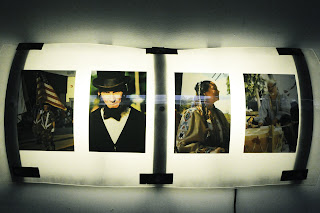
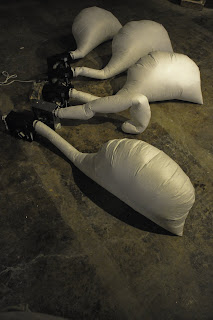
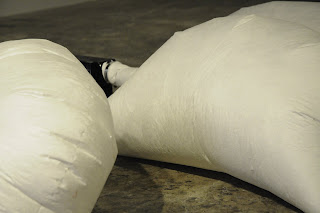
Through my hand and eye I investigate space and material as it relates to the human body in non-corporeal forms. The non-corporeality allows me to exploit my personal emotion with the security of not being publicly exposed. This is a investigation of emotion, emotions that one feels for another, emotions that one feel when they are alone, emotions that no one is really ever supposed to know.
Allowing a voyeurs view in the subconscious of their own mind. My work engages the viewer head on drawing them beyond the dimension of the work. Allowing s/he to create a personal dialogue within the images and shadows created by the piece. With emotion always comes motion, of mind body or object.
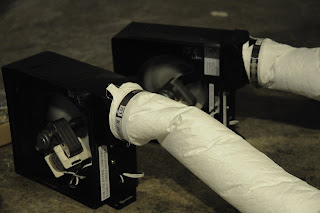
I do this by using materials that are emotionless such as plaster, steel, rubber, and plastic. They carry little to no emotional value. Industrial materials that have been appropriated to form structures, skin, and bodies. Two dimensionally through photographs that are strictly editorial, quick, unedited and documentarian in their nature. Each movement whether in 3 dimensional form to 2 dimensional form is quick, deliberate, and uninhibited. James J.Nestor


Heather Thompson


Inspired by nature and the forms that occur therein, these brooches delve into the exploration of the evolving, growing movement of life. Using the brass with white pearls is an ideal medium for this piece. Through the skeleton-like qualities of the brass section of the pieces, I want to create the feeling of death and decay of the organic form while the pearls represent the seeds that would be the next generation of life. The pearls feel as though they are dispersing out of the form to continue the circle of nature, giving the new generation a chance to grow. The crocheted forms along with the corresponding stick pin showcases the rich surfaces and curvilinear components of the work. I create perfect forms in nature in my own intuitive way with the integration of form and function found in the natural world through the organic processes of growth.

Dan Kuhn New Work


    Porcelain, Sawdust, Walnut

Artist Statement.

The permanence of ceramic materials, used in my sculptural pieces, creates a commentary on the wastefulness of today's society.  I manipulate materials to show excavation, sedimentation and geologic processes.  Subtly floating my work on refined pieces of hardwood lends to the idea of a specimen of artifact in a natural history museum.
By casting porcelain I address the false sense of importance, which is imbedded in products that are made to be obsolete, such as cell phones and computers.  Producing multiples of an everyday object is informed by artist of the Pop Art movement, such as Arman, Robert Arneson and Mishima Kimiyo.  

Tuesday, October 14, 2008

Matt Nauman - Recent Work

"Two drawers and Four shelves"

plywood, maple, sterling silver, medium density fiberboard, threaded rod, milk paint

"Table with drawer"

pin oak, maple, curly anegre veneer, medium density fiberboard, drawer glides, milk paint


Designing to confront the efficiency of common utilitarian objects, I challenge the user to question the functionality of furniture forms. Utility is a vital component to my designing process. However I do not believe the work to be utilitarian. Drawers in furniture create an alluring arrangement of space. I manipulate this space to create intrigue through the discovery of multiple internal cavities. These cavities are then assumed to be readily accessible. By incorporating mechanisms that are not associated with conventional furniture, I allow the user to create their own connection to my work. I leave the interior spaces of my drawers open and empty. This ultimately invites the user to develop his/her personal application to each piece.

alisha mccurdy


Sacral, 1440 still images from video, metronome, sewing needles, scissors, marble, wood, string.

We move through the world driven by deadlines, appointments, and due dates. As an artist, the concept of time in a studio space is a precious notion that I hold dear. It is with solemnity that I acknowledge I will not always have space in which time falls still, and that I may be left up to my own creative devices. Beyond the studio just being a space to work, it provides an environment that fosters community, transformation, and reflection. Without this notion of studio the actions and affect of an artist become deflated.

martyna matusiak

Bit(t)er animated film, progress, aprox.5:00 min


Through photography, drawing, sound, video and three dimensional works, I create numerous story lines as auto fictions[i].
Auto - because of my intension, fiction - because of the execution. My “imaginary self” or narrative with in my work, close to writings of Dostoyevsky, or attitude of Sophie Calle, goes beyond my autobiographical concerns.
I construct unspecified environments with a single character in the main role, as a tool to amplify the human state, filled with desires, expectations and the continual need for safety and comfort.
My work addresses universal concepts of fear and control that exist in every aspect of life such as ordinary events or dull everyday actions. Through mimicking the actions of absurd difficulties or delight I bring into focus the ordinary features of life fulfilled with flashes of extreme joy or misery, pleasure and pain as one.
Close to an idea of mimesis my imitation does not signify reproducing an external reality, but expressing the inner one, to underline that stability and flux, safety and hazard sometimes are one and the same.

[i] Autofiction according to Joost de Bloois “coins no less than the artistic self as an instrument of critique: 'autofiction' makes 'critique' (be it historical or institutional) run parallel to investigations into imaginaries of the self.(…) Autofiction replaces the subject's isolation by the subjects multiplication. (in) Introduction. The artists formerly know as…or, the loose end of conceptual art and the possibilities of ’visual autofiction’ Image and Narrative. Online magazine of the Visual Narrative. November 2007


Mishima Kimiyo

Kimiyo deals with the ideas of human ability to consume on a grand level.  She uses common imagery of products and creates a realistic version out of clay.  With decals, silkscreen and transfer paper she can create the illusion of a box from Del Monte.  Newspapers, magazines, boxes, bricks and trash are made to speak to the world about its' waste.  She has been addressing these issues since the 1970's and is still working today to help change our glutinous ways 

Ben Oddi - new paintings since last crit


The desire for freedom, escape, and exploration influence the narrative of my oil paintings. In my representations, I examine the possibilities of utopia and dystopia through the escapist tendency to create a parallel realism. The pictorial environment is meant to emphasize a disconnection to a tactile reality, where ideas and experiences are confused, allowing the viewer to assemble a personal narrative. By doing so, the work evokes a feeling of uneasiness through improbability; this imaginary voyage should feel familiar and sublime, with a feeling of imminent danger.
The artists Paul Noble and Neo Rauch have been contemporaries responding to similar themes, whose work I find both different and inspiring. While I study the natures of escapism related to utopian and dystopian philosophy, I do not align with one thought or the other, but choose to respond to both concerning the nature of free will. The lectures of Theodor Adorno, fictional utopian literature, and Ernst Bloch’s revolutionary utopic perspectives have shaped how I view and represent the possibility of change.

Monday, October 13, 2008

Blu


Graffiti/ street artist from Bologna. Gigantic, often just black and white creatures often painted without the help of ladders, are a trademark of the Italian artist. Blu is a forerunner of street painting technology called "magic stick", popular in Italy : long poles and attached in to it brush or the roller.

Specific " sharp" tongue of his graphic images , a quickness to respond to events of surrounding world, a little bit anarchistic way of thinking and - I think I can say - specific naivety. His piecies can be read as believe in the power of "healing pieces" presented to the large public. To have an influence, to change habits, to break stereotypes, to wake up from the lethargy. He is showing a need for peace, love, friendship, criticizing systems and making aware of absurdities.

He started painting in 2000, and now it is possible to find its works worldwide(in Brazil, Spain, England.)

Robert Adams


Robert Adams is a photographer who was influential in the movement New Topographics. New Topographics addressed the ideas of post industrial human altered land. In many ways it was an early environmental movement and Adams was an environmentalist. Finding the interesting in the visually bland was an objective of the work. Neutral yet objective approaches to the subject matter was a conflict in Adams work. He was a steward in the ideas of rejuvenating land that has been altered and polluted by humans yet wanted to be a neutral documentor of landscapes. in the words of John Szarkowski, Adams... "has, without actually lying, discovered in these dumb and artless agglomerations of boring buildings the suggestion of redeeming virtue." Craftsmanship and conservation are strong ideas attached to the work of Adams and should be investigated in today's art to see if we have kept the torch burning.

Walter de Maria


Walter de Maria is an artist influenced by Dada and Minimalist movements. He also was influenced by music as he was a drummer for a band that later became the velvet underground. de Maria created many minimalist works from Seen/Unseen Known/Unknown at the Naoshima , Kawaga Prefecture in Japan to the Broken Kilometer in New York. One of his well known works, Lighting Field, (pictured above) is a major piece in the Earthworks movement. de Maria placed 400 stainless steel poles in a grid that is one mile by on kilometer up in the high desert of New Mexico. This piece is to be experienced over a longer period of time, it is not to be looked at and walked past. the environment in which it is placed is always changing and with that so does the piece. Sunset/sunrise, winter/summer day and night this piece is interacting with the earth and should be considered as such.

Ursula von Rydingsvard


Ursula Rydingsvard creates, often massive, wooden structures/sculptures out of cedar wood. These works are intricately assembled on a intimidating scale. I have seen the works up close and they loom over a viewer. The viewer must wonder many things including the logistics of installation. each piece cut and placed and glued and carved. The number of pieces that make up the whole creates a puzzle for the eye. the carved surfaces are curved and organic where as the pieces are also square, a combination of architecturally influenced lines and strong characteristics of nature adds a layer of conflict to the surface. The cedar also creates an olfactory experience. The smells of cedar can be powerful and can trigger memories of all kinds. Worth looking at everyone...

http://www.pbs.org/art21/slideshow/?artist=189

Sunday, October 12, 2008

Zygmunt Bauman


Polish sociologist, philospoher. born 1925.


"Fluidity" is one of key words of Zygmunt Baumana in reflection about contemporary world.
how Bauman is writing -"fluid life" isn't able to keep its shape or to maintain a stable route.
Anxieties, the uncertainty are one of his traits, triggered not only by the unknown -who it always been - but by the dizzying speed of change makes impossibile to keeping up.

After tragic experience of the 20th century, of which he was a witness, a victim and a participant, Bauman cautiously is coming to temptation to write out prescriptions and to create utopia. In his writing he never even assuming the ideology. He is rather representing an attitude, and a call for ethical behaviours; With the open thinking, the mobilization for fighting the injustice.

Nan Goldin


Nan Goldin is one of the most fascinating personalities of the contemporary photography. Her work is revealing the tragedy, cruelty and death, at the same time are showing love, sensitivity and desire. Goldin is unmasking contradictions of the contemporary culture, not running away from numerous taboo subjects. She is mostly known for series of slides " The Ballad of Sexual Dependency" where she captured "her family' -mostly Drag Queens a photostory about love, aids, and death.

Hiroshi Sugimoto


Sugimoto is a Japanese photographer currently who spends his time working in Tokyo, Japan and New York City. His works include of a number of series, each having a distinct theme and similar attributes. Sugimoto has spoken of his work as an expression of ‘time exposed’, or photographs serving as a time capsule for a series of events in time. The work also focuses on transience of life, and the conflict between life and death.

Sugimoto is also deeply influenced by the writings and works of
Marcel Duchamp, as well as the Dadaist and Surrealist movements. In 1976, Sugimoto began his work with "Dioramas", a series in which he photographed displays in natural history museums. In these, he plays with our cultural assumption of truth in the photographic image. His series "Portraits", begun in 1999, were based on a similar idea. In that series, Sugimoto photographed wax figures of Henry VIII and his wives. These wax figures are based on portraits from the 1500s and when taking the picture Sugimoto attempts to recreate the lighting that would have been used by the painter.

Yves Tanguy


Despite his lack of formal training, Tanguy’s art developed quickly and his mature style emerged by 1927. His first solo show was held in 1927 at the Galerie Surréaliste in Paris. Soon after in 1928 he participated with Jean Arp, Max Ernst, André Masson, Joan Miró, Pablo Picasso, and others in the Surrealist exhibition at the Galerie au Sacre du Printemps, Paris.

Tanguy incorporated into his work the images of geological formations he had observed during a trip to Africa in 1930. He exhibited extensively during the 1930s in solo and Surrealist group shows in New York, Brussels, Paris, and London. His work was based heavily in the unconscious and the surrealist motivations for change.

Saul Williams


Saul Stacey Williams is an American poet, writer, actor and musician. Mainly known for his blend of poetry, alternative hip-hop, and for his leading role in the independent film Slam. Williams has also been a vocal critic of the Bush administration, the War on Terrorism, and the Iraq War.

Williams well-known works are the anti-war anthems "Not In My Name" and "Act III Scene 2 (Shakespeare)". In early 2008, a Nike Sparq Training commercial featured Williams' song "List of Demands (Reparations)."
He currently resides in Los Angelos, California.

http://www.youtube.com/watch?v=jzY2-GRDiPM

http://www.youtube.com/watch?v=oQ_o660d0oc

Dave Hickey


Like him or not, Dave Hickey is one of the most well known contemporary art critics . Dave is infamous for his strong arguments against the role of academics in art. Hickey has authored fiction and music, run art galleries, and lectured extensively around the world. A recipient of the MacArthur Fellows Program"Genius Award" in 2001, Hickey's criticism is generated through personal experiences. Like all other critics, shy is not in Hickey's vocabulary. He is known for his direct "in your face" criticism. Going beyond his personal associations, Dave anticipates and welcomes the experiences of people who may or may not agree with him. Since 1992 he has taught art theory, art criticism, and creative writing at University of Nevada, Las
Vegas.

Michele De Lucchi


Michele De Lucchi is a Italian architect and designer. He moves between furniture, interior design, lighting, and interior and exterior architecture. He studied architecture at Padua and Florence until 1975. While still a student, De Lucchi teamed up with Ettore Sottsass, Alessandro Mendini and Andre Branzi in 1973 to form Cavart, a radical design group which put on Happenings and held seminars in and around Padua. Along with Cavart, De Lucchi was part of Alchymia and Memphis. His comical approaches to the creation of new styles in architecture and design played an important role in the Cavart, Alchymia, and Memphis movements.

Saturday, October 11, 2008

Martin Buber


Martin Buber ( 1878-1965). Jewish philosopher- writer- translator, born in Vienna. He was a researcher of the Hasidism. This religious-philosophical position formed a way of his thinking. His philosophy is based on : "I- Thou" ( dialogue), "I- it"(monologue).


A real life is "a meeting", our "I" is always towards something. The crisis of the relation is a crisis of the man. The man is entering the monologue- relation with reality "I - it", and dialogue- "I - Thou". In the relation "I- it" a dialogue is missing, but it is essential for the human life.


The problem relies on it, that people instead of to enter the dialogue- are monologuing. They are making this way, because they are afraid to reveal. Sometimes they are creating appearances of the dialogue.

Buber is criticizing both :the collectivism, and the extreme individualism, because we should be both for oneself, and for somebody else.


"The world is not comprehensible, but it is embraceable: through the embracing of one of its beings. Each thing and being has a twofold nature: passive, absorbable, usable, dissectable, comparable, combinable, rationalizable, and the other, the active, non-absorbable, unusable, undissectible, incomparable, noncombinable, nonrationalizable. This is the confronting, the shaping, the bestowing of things. He who truly experiences a thing so that it springs up to meet him and embraces him of itself has in that thing known the world..." - Martin Buber


Friday, October 10, 2008

Quay Brothers


Stephen and Timothy Quay, twin brothers, are authors of film animated films and TV commercials. They directed two feature-length films and a lot of short animated films.Most famous "Street of Crocodiles"- adaptation of B. Schulz and "Institute Benjaminata"
The are working somewhere on edge of culture - against desire for being "pop"for almost thirty years.
Films of Quay brothers don't let themselves forget.Because their's images are simply moving photographs, classic animated films with using heartless dolls, puppets. The created theirs own world, in which everything is unique, with it;s own rules. Everything is dynamic, indescribable, broken, stretched, torn. Inspired by German expressionism, surrealism, and avant-garde.

Monday, October 6, 2008

Cacteau Twins


Cocteau Twins - bend existing from 1981-1998. They came from Grangemouth, Scotland.

The music of Cacteau Twins is called " a dream pop". The music was characterized by a simple guitar tone which gave a mystery mood. A delicate Elizabeth Fraser's vocal supplemented everything - sung in made up or twisted language.
Allmusic reviewer Ned Raggett writes that "part of her appeal is how she can make hard-to-interpret lyrics so emotionally gripping."

Julio Cortazar


Julio Cortazar- an Argentinian author of novels and short stories .(1914-1984)


"hopscotch"


The book is game, fun with readers in fact. It is possible to read it to different ways discovering new contexts every time. Differently it will be understood if we read chapter after the chapter, differently "jumping"according to authors's key. Possibilities are endless and new motifs and endings are arising.


Story of two young people wandering around streets of Paris is a point of departure for the book. From this journey , deliberations about literature, the art, the meaning of the being and nature of the world starts . A constant search which is keeping main characters company from beginning to the end.

Sunday, October 5, 2008

Arturo Rivera


Arturo Rivera is a contemporary Mexican painter that cam into recognition around 1970 for his form of hyper-realism. Perfecting is imagery and technique through the 1980's and 90's, Rivera in 2005 won first prize at the Beijing International Art Biennial.

His scenes are dark, macabre, and occasionally anatomic perversions. Self portrait has always been an element in Rivera's work that both lets the artist develop an alter ego and investigate self.

http://www.arturorivera.net/

MF DOOM


Daniel Dumile is a british born American Hip-hop artist who has taken on several stage names in his career, most famously MF Doom. Dumile began to rap at open mic events at the Nuyorican Poets Cafe in 1998 where he withheld his face by putting a stocking over his head. His new identity was influenced by Marvel Comics supervillain Doctor Doom. Dumile wears the mask while performing and isn't photographed without it, except for very short glimpses in a few videos.

Dumile creates socially critical and conscious lyrics based around many of his own experiences of living homeless. Usually the lyrics are a made up narrative that Dumile uses to express points of view.

http://www.myspace.com/mfdoom

Friday, October 3, 2008

Gary Knox Bennett


Residing in Oakland Ca. , internationally known furniture maker, Gary Knob Bennett is currently represented by Leo Kaplan Gallery, NY. Showing a series of 52 chairs at the Delaware Art Museum. Bennett is known for unconventional materials and exploratory objects. One of few furniture designers who has been able to combine the realms of of sculpture and furniture. He approaches designs like a sculptor would their work. He builds on the fly, incorporating an array of materials and objects to suit each piece. There is no limit to what Bennett is willing or has tried. His furniture exhibits functionality and meticulous detail and craftsmanship. Now in his 70's and still producing , Bennett is referred to as "the oldest of the second generation of studio furniture makers."

Thursday, October 2, 2008

John Isaacs

English-born artist John Isaacs explores contemporary experience though a variety of media. A dark and cynical sense of humor mixed with the gothic and grotesque, is expessed in each work. Isaac works in sculpture, video, installation, photographs and paintings in order to depict an odd spectacle that, in the artist's words, are: "places we can get lost and the utopias we dream of. The wrong turns we take, directed by ego or fear, and ultimately the way we learn to forget the beauty of the world we live in."

Isaacs is a graduate of Slade School of Fine Art and attended Ecole des Beaux Arts in Dijon. He is currently exhibiting with Aeroplastics Contemporary in Brussels and has exhibited with Museum 52 in London, Murdeme Collection at the Serpentine Gallery in London, and has been a guest lecturer at The Getty Foundation in Los Angeles. Also, Art in America reviewed John Isaacs's exhibition at Feign Contemporary Art in 2003.

http://isaacs.aeroplastics.net/

Wednesday, October 1, 2008

Haruki Murakami


Murakami is the foremost contemporary Japanese novelist who weaves fantastical and surrealist tales set in present day Japan. His work is strongly influenced by western culture and writers such as Kurt Vonnegut and Richard Brautigen. Themes of western music and literature are throughout his novels and short stories. One of his best-known books written in a four year span in the U.S. teaching at Princeton, The Wind Up Bird Chronicle: The Thieving Magpie, refers to Rossini’s orchestral overture. Also, Norwegian Wood, after a Beatles song, and South of the Border, West of the Sun, from Nat King Cole. Murakami gained wide acclaim in the U.S. for Kafka on the Shore, (2002) a novel that follows Kafka, the protagonist’s Oedipal journey.

Roman Opalka


Roman Opalka French artist, with Polish origins, set out in 1965 to count from one to infinity. Starting in the top left-hand corner of the canvas and finishing in the bottom right-hand corner, the tiny numbers are painted in horizontal rows. Each new canvas, which the artist calls a 'detail', takes up counting where the last left off. Over the years there have been some changes to the ritual. In Opalka's first details he painted white numbers onto a black background. In 1968 Opalka introduced a tape recorder, speaking each number into the microphone as he paints it, and he also began photographing himself standing before the canvas after each day's work, a ritual bookkeeping of time passing. The process is endless, but measured against its goal, infinity.

Ahlam Shibli, (1970-) Palestinian artist


In an important part of Ahlam Shibli’s photographic work, the artist takes her central theme the definition of home; mainly through the everyday living conditions of the Palestinian people. Shibli’s work stems from the tradition of photographers who have documented the life of the Palestinian people since the late 19th century. Her photographs depict unfinished houses, densely built areas dotted with satellite dishes, deserted plains, concrete rubble—and nowhere is home. Black and white archival photographs from Palestinian families are shown, like portable memorials to time past.

William Kentridge


William Kentridge is a animator and scene depicter of South African origin.  His work is often theatrical in nature in the sense of impending movement of everyday scenes.  Working with the landscapes around him and objects of little everyday interest he creates a narrative in his mind that does not play out to the audience.  He will find the beauty in a landscape and then draw the view that is behind him, wishing the viewer to see the interest in the mundane.  Politics plays a role, but only because it is a direct effect of his life.  Kentridge is a leader in movement of life and how it is drawn

Kurt Vonnegut


Kurt Vonnegut was a twisted story teller.  His style, which is often followed by authors and screen play writers today, gave the reader a insight into the mind of the author with out them even knowing, in a way making the reader think it was an idea or statement that was already there.  His stories about the depravity and silliness of the human race twisted and turned, shocked and dismayed until the reader understood that they were not sitting on the sidelines but were imbedded in the whole disgusting mess we call earth.  Labeled a fiction writer it was unclear what was truth and who decided. A prolific writer, Vonnegut continued to write till the last few years of his life giving the world a sobering depiction of its self.

Robert Arneson


Robert Arneson started his art life as a draftsman and cartoon creator for a local paper in Benicia, CA.  His satirical work in clay certainly has its roots in the subject matter of the funny pages.  Arneson sculpted large busts, suburban landscapes, and political figures.  He was influenced by the expressionist, and clay artist, Peter Voulkos.  Arneson shed the stereotype of clay for utilitarian uses.  Some of his most famous works were self portraits which he used to comment on universal issues.  His work was in the movement of Pop Art which lent ideas of mass cultural and technological issues.  Arneson’s work is a testament to the idea that clay is a universal material and it is to be used by all.

Toshiko Takaezu


Toshiko Takaezu is a ceramic artist that was born Hawaii in the early part of the 20th century.  Takaezu’s medium to large scale,  wheel thrown sculptures are vessels of her natural surroundings.  She believes that cooking and growing vegetables is just as natural as making her sculptures.  The treatment of the surfaces shows dramatic landscapes, in a subtle manner, of her childhood.  The large forms, when displayed outside, show the true organic aesthetic of her work thru the gentle curves and soft surfaces.  Takaezu’s work is collected around the world and she is indeed a current master.

Aline Favre

Aline Favre is a contemporary artist who mixes natural forms with a contrast of materials.  Coarse black bases and pure white sculptural pieces are balanced precariously and imply a sense of movement.  Favre's pieces are much like waves of porcelain crashing on beaches of basalt.  Layered clays have a feel of sedimentary collection, catching the motion of a wave from thousands of years ago.  The scale of Favre's work is one that is not quite floor size yet a little to big for a pedestal which brings to light some questions on the work.  Was it the intent to make the work so that it is in limbo or was that not the case at all? With such clean differences and a asymmetrical shape a natural sense is caught in beautiful and elegant way. 

Paul Soldner

Soldner is an artist born on the early 40's.  He was heavily influenced by the Abstract Expressionist movement and still creates many abstract objects.  I the late 1950's he experimented and developed what is now called American Raku.  He had read Bernard Leach's book and decided he wanted to try a technique described in the text but his outcome was not as interesting has he had hoped.  Soldner was using a 15th century Japanese technique to fire pots and pull them while they are red hot (or around 1800 degrees)but it was not until he decided to roll them in some leaves that things changed.  The introduction of combustibles created an atmosphere that reacted with the glazes causing them to flash brilliant colors.  Soldner was honored with the title Father of American Raku and has lead many artists to experiment with the essence and unpredictability of Raku.